You have probably seen the words on a university website and wondered whether they mean something different from plain accounting. Short answer: not really. Accounting science is a degree-title convention. Wits runs a BAccSci, Pretoria a BCom Accounting Sciences, Unisa applies the Bachelor of Accounting Science label to several different qualifications. In South Africa the label is institutional rather than a separate field of study. What actually decides where a programme takes you is its SAICA endorsement, the Mathematics requirement at matric, and what you want to do afterwards.
First, some scale. This pipeline is narrower than it looks. South Africa's public universities enrol just over a million students. In January 2026, 3 171 candidates sat SAICA's first professional assessment, and 2 055 passed. A million students in, two thousand through the gate. SAICA counts more than 60 000 members and associates across its three designations: CA(SA), AGA(SA) and AT(SA). That is about one for every thousand South Africans. And SAICA is not the whole profession. SAIPA registers professional accountants under the PA(SA) designation, and CIMA and ACCA members practise here too.
What is accounting science?
Accounting science is the title used by several South African universities for undergraduate degrees covering financial accounting, management accounting, auditing, taxation and commercial law. Programmes carrying the name are usually structured as the academic stage of a professional accounting qualification. Endorsement by a professional body, most often SAICA, determines which designations the degree can lead to.
Accounting science vs accounting
The difference is mostly structural rather than academic. Universities name and sequence their programmes differently, so a BAccSci at Wits, a BCom Accounting Sciences at Pretoria and a BCompt at Unisa can cover similar ground while being built quite differently.
Institution | Programme name |
|---|---|
University of the Witwatersrand | BAccSci, Bachelor of Accounting Science |
Unisa | BCompt, Bachelor of Accounting Science |
University of Pretoria | BCom Accounting Sciences |
Stellenbosch University | BAcc, Bachelor of Accountancy |
Various | BCom Accounting, Bachelor of Accounting |
Source: SAICA list of endorsed and recognised programmes, updated 20 January 2026.
Worth knowing: you cannot shop by degree title. Two programmes with the same name at different universities can carry different endorsements, and two programmes with different names can lead to exactly the same designation.
Unisa is the clearest illustration. It applies the Bachelor of Accounting Science label to several distinct qualifications, covering financial accounting, taxation, management accounting and internal auditing, and those qualifications do not all lead to CA(SA).
So check the SAICA endorsed programmes list for the year you intend to enrol, and match the programme code rather than the programme name. It is the authoritative reference, and it is republished annually.
Entry requirements
Requirements differ by institution and are set for each intake year, so treat any figure you read on a third-party site as out of date until you have confirmed it on the faculty page.
Institution | APS | Mathematics | Maths Lit accepted? |
|---|---|---|---|
University of the Witwatersrand, BAccSci | Above 43 | Level 6 or higher | No |
University of Pretoria, BCom Accounting Sciences | 34 | Level 6, so 70% or higher | No |
Unisa, BCompt in Financial Accounting | 21 | 50% | Yes, at 60% |
Wits also requires English at level 6 and, on its published guidance, wait-lists applicants sitting at an APS of 39 to 43 with English 6 and Mathematics 6.
UP requires English Home Language or First Additional Language at level 5. Unisa requires 50% in the language of teaching and learning, and allows up to eight years to complete the degree.
Sources: University of Pretoria Yearbook 2026, programme 07130045. Unisa, Bachelor of Accounting Sciences in Financial Accounting, 98302-FA1. Wits, undergraduate entry requirements.
All checked August 2026.
Three mechanics catch applicants out:
Life Orientation does not count. UP excludes it when calculating the APS, which changes the arithmetic more than people expect.
Grade 11 is the year that matters. UP requires Grade 12 applicants to apply on their final Grade 11 results. The marks that get you in are already behind you.
The minimum is a floor, not a ticket. UP says so explicitly, and the specialisation modules on the BCom Accounting Sciences are reserved for students selected for the degree. Unsuccessful applicants are notified after 30 June.
For reference, the UP degree is three years minimum, 453 credits, at NQF level 7, full time only. SAICA accredits it together with the full-time Postgraduate Diploma in Accounting Sciences, not on its own.
What you study, year by year
Curricula differ by institution, so the useful thing is to look at one in detail rather than average them into mush. The University of Pretoria BCom Accounting Sciences is a good reference case, because it shows where the sector is heading.
Year | Modules | Credits |
|---|---|---|
First | Business acumen 100, Financial reporting 100, Financial decision-making 120, Economics 110 and 120, Business management 114, Informatics, Statistics, academic literacy | 155 minimum |
Second | Business acumen 200, Financial reporting 200, Financial decision-making 200, Governance and assurance 200, Taxation 201, Commercial law 201, Professional ethics 221, HR management 220, Informatics 264, Applications in data science 212 | 152 minimum |
Final | Business acumen 300, Financial reporting 300, Financial decision-making 300, Governance and assurance 300, Taxation 301, Design thinking and business 317, Informatics 324 | 146 minimum |
Postgraduate, PGDA and CTA | Integrated, case-based coverage of the technical disciplines, one year full time | Separate qualification |
453 credits over three years.
Source: University of Pretoria Yearbook 2026, programme 07130045.
Look at the naming. There is no module called "Financial Accounting 3". UP has restructured its accounting degree around competencies rather than subject silos. Three threads run from first year to final year and deepen each time: business acumen, financial reporting, and financial decision-making. Governance and assurance joins in second year. Taxation and commercial law sit alongside them. The integrating module is Business acumen, taught jointly by four departments: accounting, auditing, financial management and taxation.
That matters for two reasons. It mirrors how SAICA now assesses candidates, on integrated thinking across disciplines rather than topic by topic. And it means the traditional "which subjects do I take" framing does not map cleanly onto every programme any more. Rhodes still requires Accounting 3, Auditing 3, Taxation 3 and Management Accounting and Finance 3 by name. Check the yearbook, not the assumption.
The postgraduate year on that last row is a separate qualification, and the assessment that follows it is where the integrated standard bites: 77% of first-time candidates passed the January 2026 IAC, and 65% of all candidates.
Subjects on the CA(SA) route
When people search for chartered accountant subjects, they are usually not asking for a module list. They are asking what the route actually looks like. Here it is.
Stage | What it involves | Typical duration |
|---|---|---|
Matric | English, and Mathematics at the level your chosen programme demands, plus marks that clear the APS floor | Grade 12 |
SAICA-endorsed undergraduate degree | BAccSci, BCompt, BCom Accounting Sciences or equivalent | 3 years |
SAICA-endorsed postgraduate programme, PGDA | Compulsory, and required before you are eligible to sit the IAC | 1 year |
Training contract | Registered SAICA trainee at an accredited training office. The three steps below all happen inside it | 3 years full time, 5 years part time |
Initial Assessment of Competence, IAC | First professional assessment, written once the PGDA is complete | 1 sitting |
Professional programme, also called the board course | Prepares candidates for the final assessment and for the ethical and practical demands of the job | Inside the training contract |
Assessment of Professional Competence, APC | Final professional assessment, written from 20 months into the training contract | 1 sitting |
SAICA membership | Registration as CA(SA), after the remaining months of the contract are served | Roughly year 7 |
Source: SAICA, the CA(SA) roadmap, checked August 2026.
The sequencing is not a queue, and this is where most guides get it wrong. The postgraduate year comes first and it is compulsory: you are not eligible to sit the IAC until the PGDA is done. Everything after that happens inside the training contract. The IAC, the professional programme and the APC are all written or completed while you are employed as a trainee, and the APC cannot be pulled forward because it requires 20 months of the contract already served.
If you study part time, the training contract runs five years rather than three.
One more thing worth knowing before you go looking. SAICA's own published roadmap still refers to the ITC rather than the IAC, more than a year after the renaming. If official documentation is inconsistent about it, third-party guides certainly will be.
The technical content assessed at professional level is narrower than the undergraduate syllabus and considerably deeper: decision making, financial and non-financial reporting, strategy, risk management and governance. SAICA now layers business acumen, digital acumen and human-centred skills over that technical core.
What changed with the IAC*
If you are reading older guides, they will talk about the ITC. That exam no longer exists under that name.
SAICA renamed the Initial Test of Competence as the Initial Assessment of Competence, effective from the January 2025 sitting, to align with its CA of the Future Competency Framework. The format changed with the name, from four papers to three, each out of 120 marks for a total of 360. SAICA has said the IAC will keep absorbing competency-based components through 2026 and 2027, including a new-format third paper.
The January 2026 IAC produced a 77% pass rate for first-time candidates, down from 82% the year before. Across all candidates, including repeats, the rate was 65%: 2 055 passes out of 3 171. Candidates funded through the Thuthuka Education Upliftment Fund passed at 80%. Source: SAICA media release, 10 April 2026.
Read that pass rate correctly. It applies to people who have already finished a three-year degree and a postgraduate year, so it is a filter applied to an already filtered
Where to study
The five programmes below performed strongest in the January 2026 IAC, on the figures each institution published after SAICA released the results on 10 April 2026. Pass rate is not the only thing that should decide where you study, but it is the one objective, current, publicly reported measure of how well a programme prepares candidates for the assessment that gates the profession.
One caveat, a real one: these figures are not strictly comparable. Some institutions report first-time candidates only, others report all candidates including repeats, and each picks the national benchmark that flatters the comparison. Read each number with its definition attached, which is why we have given both below.
This list is not exhaustive. Stellenbosch University, the University of the Free State and Nelson Mandela University all run well-regarded SAICA-endorsed programmes and are worth adding to a shortlist.
North-West University
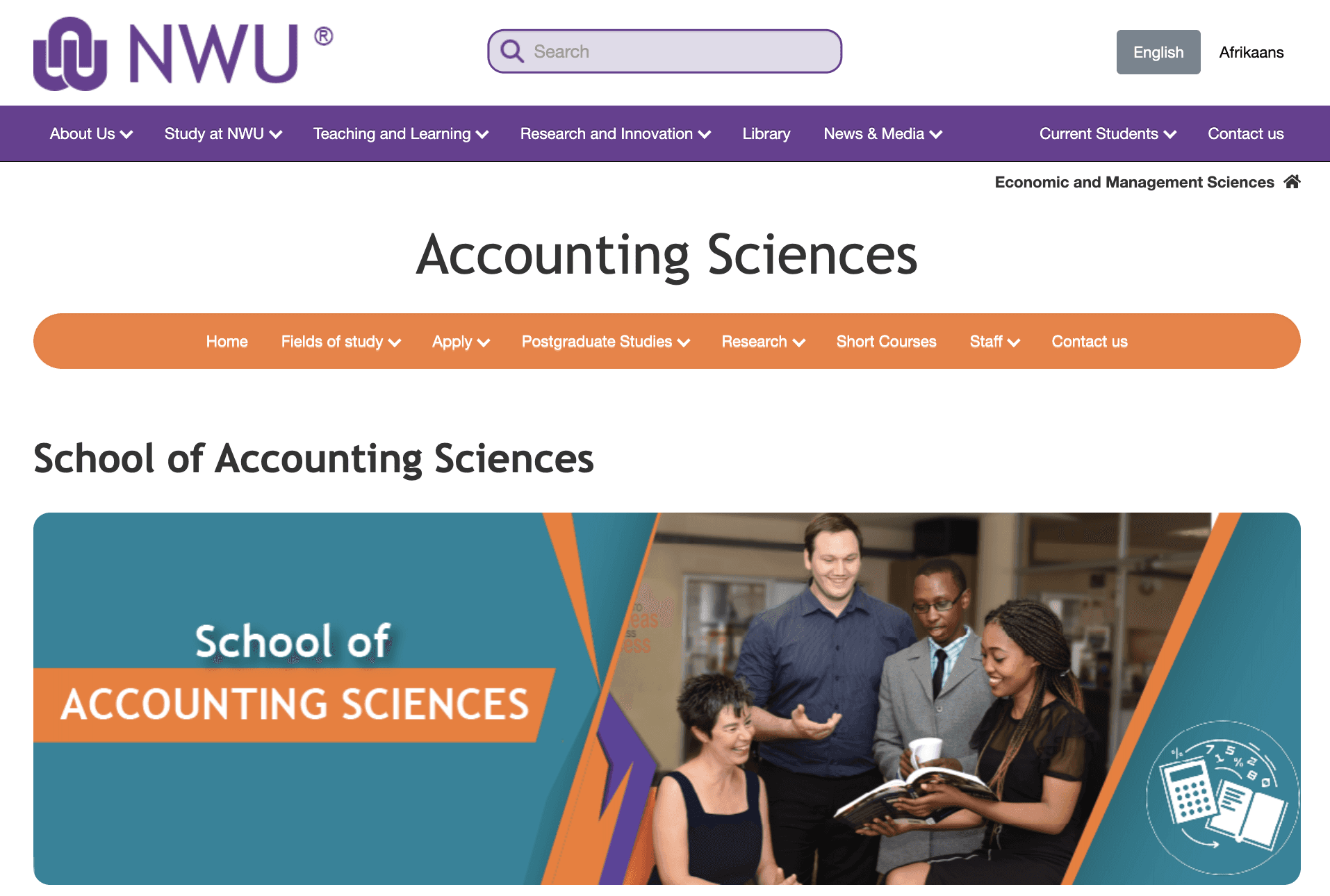
97% pass rate in the January 2026 IAC, on first-time candidates
122 NWU candidates passed the SAICA and ICAN assessments
95% pass rate among its African, Coloured and Indian candidates
NWU's School of Accounting Sciences posted the highest headline figure of the 2026 cycle. The 97% is a first-time-candidate rate, and NWU compared it publicly to the 65% all-candidate national average, which flatters the gap. Against the fairer benchmark, the 77% national first-time rate, it is still 20 percentage points clear.
The programme runs across the Potchefstroom, Mahikeng and Vanderbijlpark campuses, and NWU also has a substantial distance-learning operation, which is worth checking against your circumstances rather than assuming the contact-mode results transfer.
Programme page: commerce.nwu.ac.za
University of Pretoria
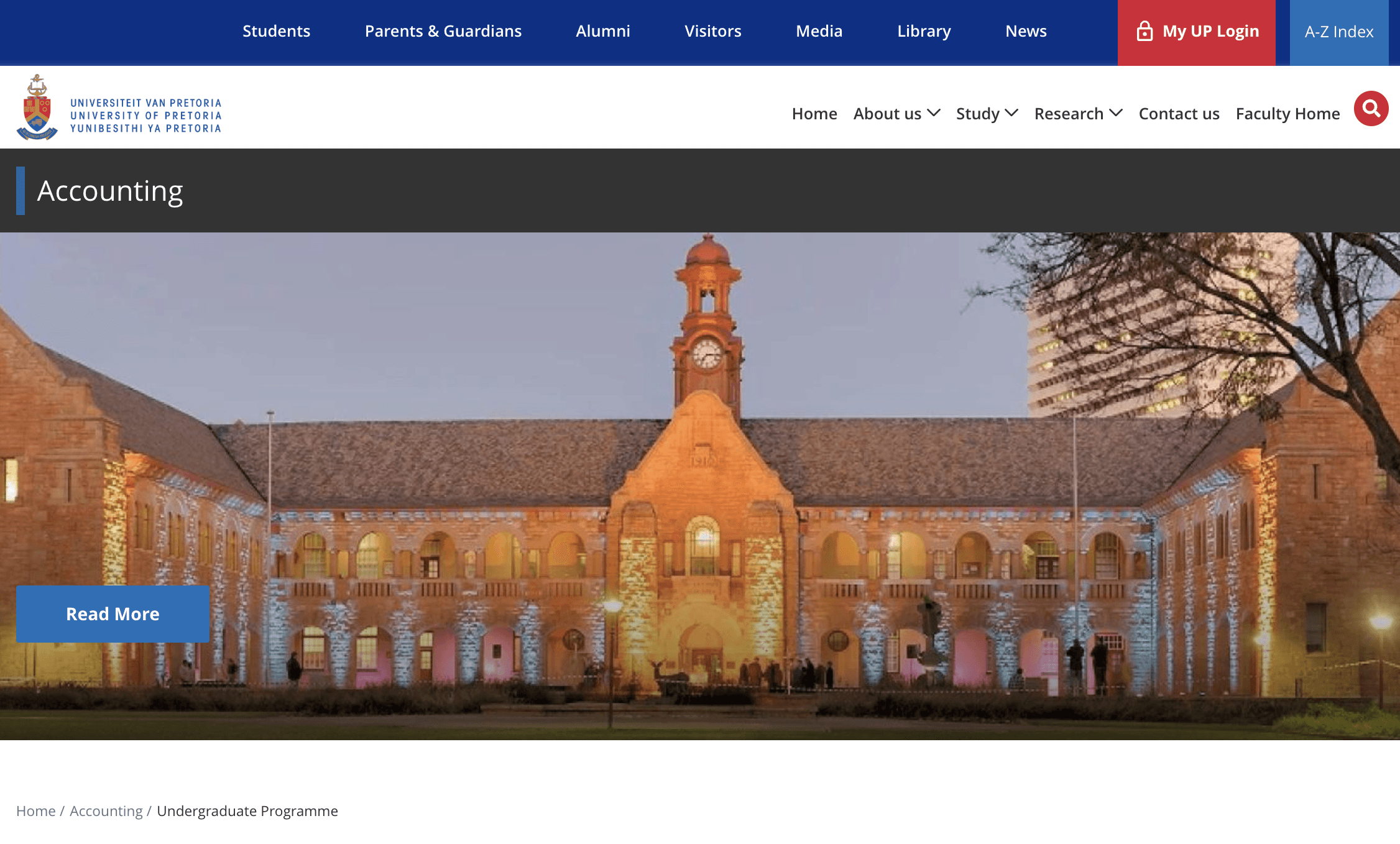
96% pass rate in the January 2026 IAC
Six candidates on the national honours roll, the most of any institution
Two candidates in the national top 10, placed 3rd and 10th
UP's CA Programme pairs the BCom Accounting Sciences with the Postgraduate Diploma in Accounting Sciences, and SAICA accredits the two together. It is the programme we used as the reference curriculum earlier, because it has gone furthest in restructuring around competencies rather than subjects.
Entry is the tightest of the five: APS 34 with Mathematics at achievement level 6. Selection runs above that floor, and the specialisation modules are reserved for students admitted to the degree.
Programme page: up.ac.za CA Programme · Yearbook entry
University of Cape Town
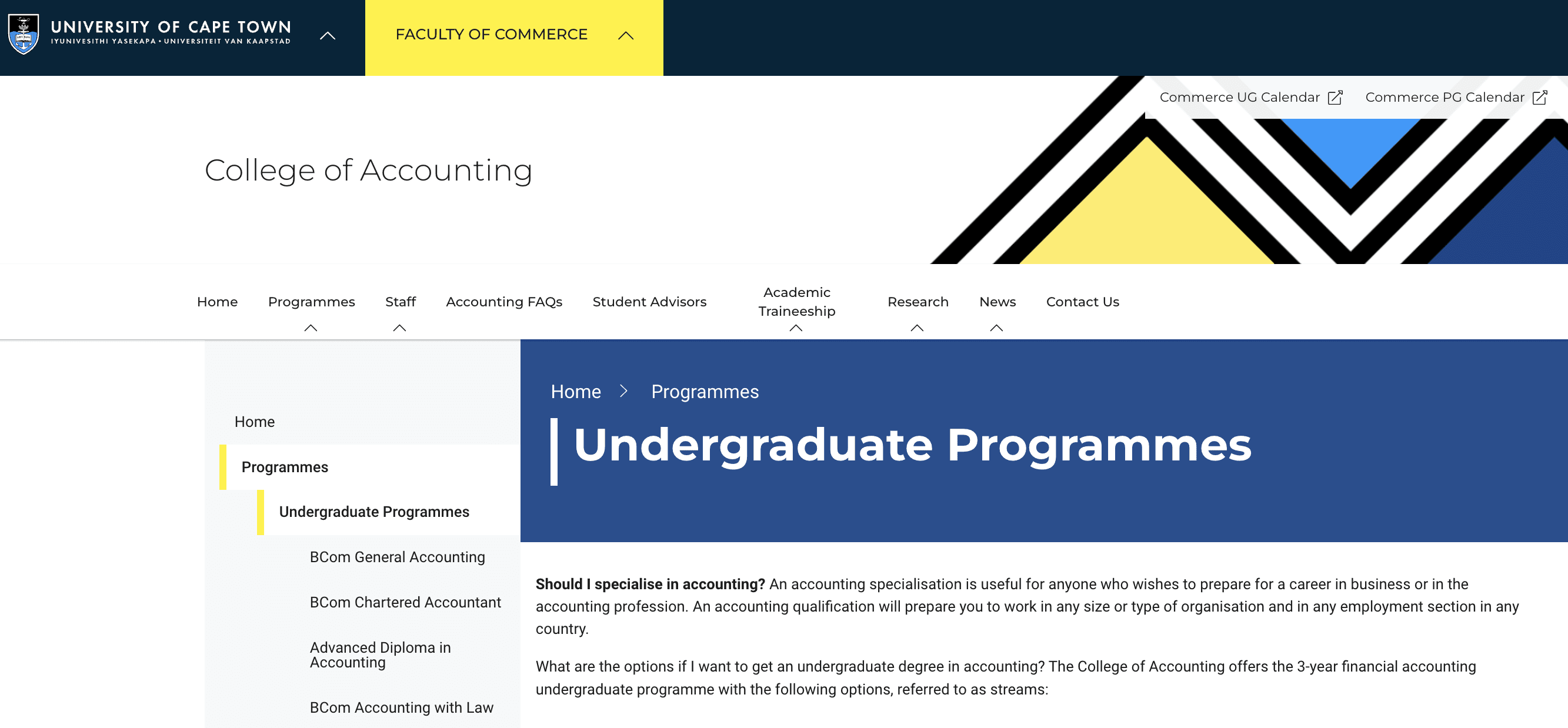
96% pass rate in the January 2026 IAC, first-time candidates only
188 of 196 candidates passed, up from 150 passes in 2025
90% of the 2025 PGDA class passed the IAC at the first attempt
UCT publishes the most transparent numbers of the group, which is worth something on its own. It gives the raw counts, states that no repeat candidates are included, and reports throughput on the full PGDA cohort rather than only on those who sat.
Five UCT graduates made the 23-strong honours list and four of those placed in the national top 10. UCT also runs a Preparatory Board Course open to students from any university preparing for the January or June sittings, which is a useful detail if a first attempt does not go to plan.
Programme page: commerce.uct.ac.za
University of the Witwatersrand
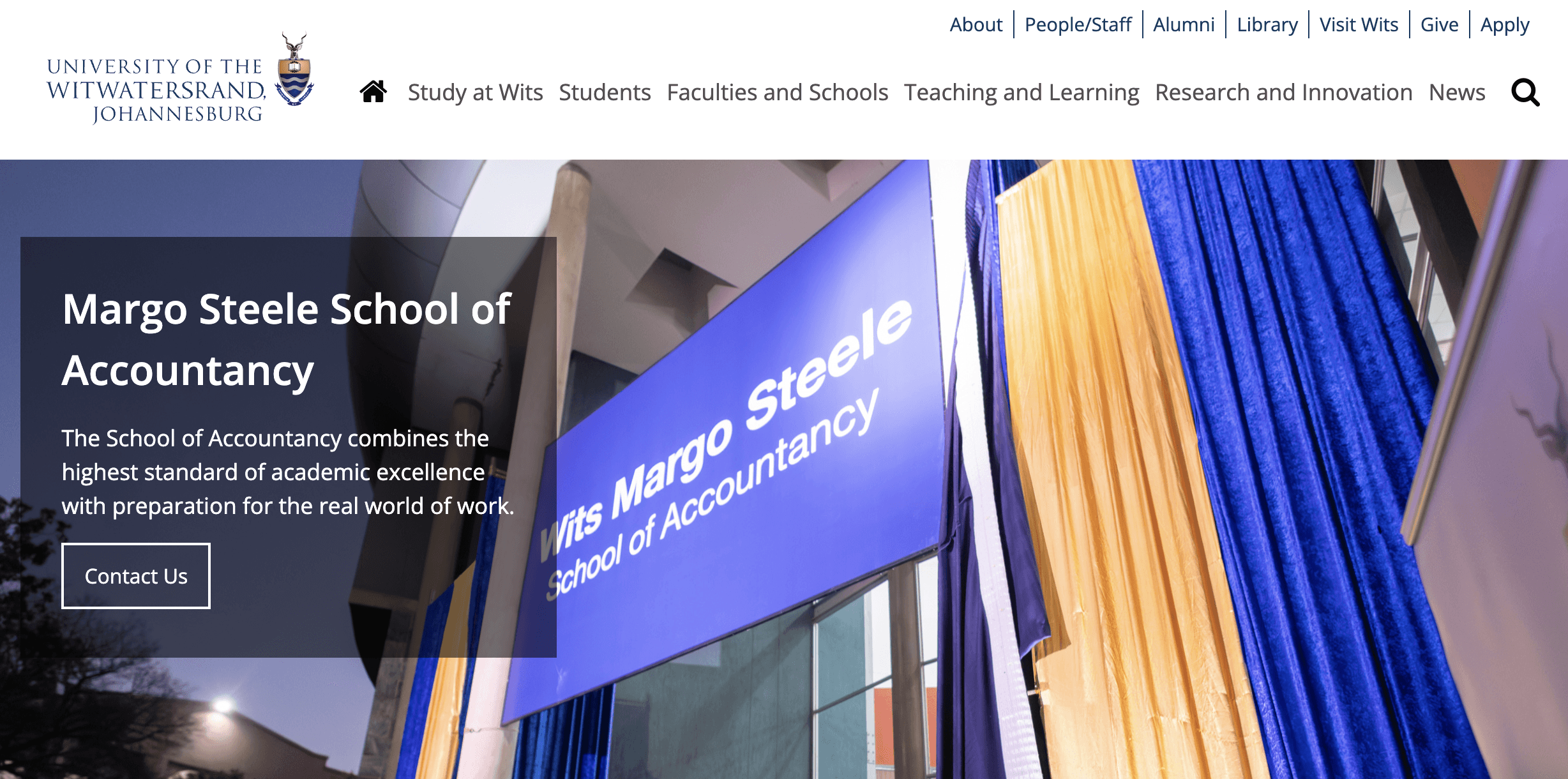
88% pass rate in the January 2026 IAC, across all candidates
The top-placed candidate in the country came from Wits
100% pass rate among its Coloured candidates, 86% among African candidates
Wits reports on an all-candidate basis, repeats included, which makes its 88% harder-won than a first-time-only figure of the same size. Against the 65% all-candidate national average it is 23 percentage points clear.
The Margo Steele School of Accountancy has built its reputation on doing volume and transformation at the same time rather than trading one for the other. Its Thuthuka candidates passed at 87% and its Margo Steele Bursary candidates at 90%.
Programme page: wits.ac.za/accountancy
University of Johannesburg

86% pass rate in the January 2026 IAC, first-time candidates
249 candidates passed, up from 207 in 2025
196 African candidates passed, up from 154 the previous year
UJ has the lowest headline rate of the five and arguably the most interesting trajectory. It grew its cohort and its absolute number of passes at the same time, which is harder than holding a high percentage on a small, tightly selected group.
UJ has also helped the University of Limpopo and the Namibia University of Science and Technology reach SAICA accreditation, and is working with the University of Zululand and the University of Venda towards theirs. If you are weighing access alongside outcomes, that record is relevant.
Programme page: https://www.uj.ac.za/faculties/college-of-business-and-economics/schools/school-of-accounting/
Before you apply: a checklist
Confirm the exact programme code appears on the current SAICA endorsed list.
Confirm the Mathematics requirement for your target programme and intake year.
Calculate your APS on your best six subjects, excluding Life Orientation.
Check whether the postgraduate stage is offered at the same institution.
Ask the faculty what proportion of a first-year cohort completes in minimum time.
Compare contact and distance options against your actual circumstances.
Identify two designations you would accept, not one.
Note the application window. Several universities close in the year before intake.
Careers and earnings
Audit is the most visible destination and the least representative one. Most graduates end up in commerce and industry, in mid-sized practices, in tax or advisory, inside a company's finance function, or eventually running something of their own.
Published salary data for South African accountants is thin and the sources disagree, so read the table as orientation and nothing more.
Role | Reported average | Source |
|---|---|---|
Bookkeeper | R213 953 per year | |
Senior bookkeeper | R293 614 per year | |
Accountant | R307 431 per year | |
Chartered accountant | R457 639 per year | |
Chartered accountant, Johannesburg | R765 000 per year, 25 reported salaries | |
CA(SA), median | R1 400 000 per year | Talent.com, 4 974 salaries |
CA(SA), experienced | up to R6 840 000 | Talent.com |
*All of these come from open salary platforms built on self-reported data and job adverts. They indicate scale, and the professional bodies' own remuneration surveys are not public.
What the degree does not teach
Here is the part no prospectus covers, and it will matter more to your first two years of work than any module on the list.
The syllabus assumes financial records exist.
In South African small business, that assumption often does not hold. FinMark Trust's FinScope MSME Survey 2024, a nationally representative study based on 4 027 face-to-face interviews with small business owners, found that 41% of MSMEs keep no financial records at all. Among the 59% that do, a manual system is the most common method at 42%, and 19% keep the records in their head.
Who does the work is just as telling. Forty-five percent of owners do the books themselves. Only 16% have an accountant doing it, and 20% a bookkeeper. On software, Pastel sits at 15% and Xero at 4%.
Cash is still the default. Ninety-four percent of MSMEs use cash, down from 97% in the previous survey wave, while use of digital financial services has climbed from 58% to 79%. Fifty-six percent of MSMEs are informal.
So you will spend three years on the accounting treatment of complex instruments, then spend your first month rebuilding twelve months of a client's trading from a bank statement that mixes the business with the groceries, because there was no business account and no ledger.